A low stress ham radio exam is not about treating the FCC question pool casually. It is about replacing uncertainty with a clear plan: know what you are studying, understand the remote testing process, and give yourself enough practice to recognize when you are ready. Whether you are pursuing your first Technician license or upgrading to General or Extra, confidence grows from preparation that feels manageable.
For many candidates, the hardest part is not a circuit theory question or a rule reference. It is the worry that they will freeze, misunderstand instructions, or discover a problem with their testing setup minutes before the session begins. A thoughtful approach can reduce those distractions while keeping the exam process serious, secure, and fair.
Start With the License You Actually Need
The best study plan begins with the right destination. The Technician license is the entry point for most new amateur radio operators. It gives access to valuable VHF and UHF privileges, local repeater communication, and selected HF privileges. It is a practical choice for people interested in local emergency communications, public service events, repeaters, and getting on the air quickly.
General Class opens much broader HF operating privileges and is often the next step for operators who want to communicate farther beyond their local area. Amateur Extra requires the most detailed knowledge and grants the highest level of privileges. Each exam is a 35-question multiple-choice test drawn from its current question pool, so you do not need to study material that belongs to a different license class.
Choosing one clear goal keeps your preparation focused. If you are new to the hobby, do not let Extra Class topics make Technician material feel harder than it is. If you are upgrading, build from what you already know, but give new regulations and technical subjects the attention they deserve.
Study for Understanding, Then Practice for Confidence
Memorizing answers can help you recognize familiar wording, but understanding the reason behind an answer makes the knowledge more dependable. This is especially useful when a question is phrased in a way that feels unfamiliar or when test-day nerves make recall slower than usual.
Work through the question pool in small, consistent sessions. Thirty focused minutes several times a week is often more effective than a single exhausting weekend of cramming. After each session, spend time on the questions you missed. Ask whether the issue was a missed fact, an unfamiliar term, or a calculation you need to repeat.
Practice exams are one of the most useful readiness checks. Take them under reasonably realistic conditions: no searching for answers, no interruptions, and no rushing. Your first few scores may be uneven. That is normal. The goal is to identify patterns, not to judge yourself.
A reliable benchmark is to pass several practice exams in a row with room to spare. Passing one practice test by a single question may mean you are close, but it can also mean your result depended on a few favorable guesses. Repeated strong scores indicate that you can handle a different selection of questions on the actual exam.
Turn missed questions into a short review list
Avoid restarting the entire question pool every time you miss a handful of questions. Instead, keep a simple review list of subjects that need another look. It might include frequency privileges, operating procedures, electrical safety, antennas, propagation, or basic calculations.
Review that short list before your next practice exam. This approach creates visible progress and prevents the common feeling that there is always too much material left to learn. As your list gets shorter, your confidence becomes based on evidence rather than hope.
Make Remote Testing Familiar Before Test Day
Testing from home removes travel time and the pressure of finding an unfamiliar testing location, but it still requires preparation. A remote exam session uses procedures designed to protect the integrity of the FCC examination. Knowing what to expect helps those procedures feel routine rather than intimidating.
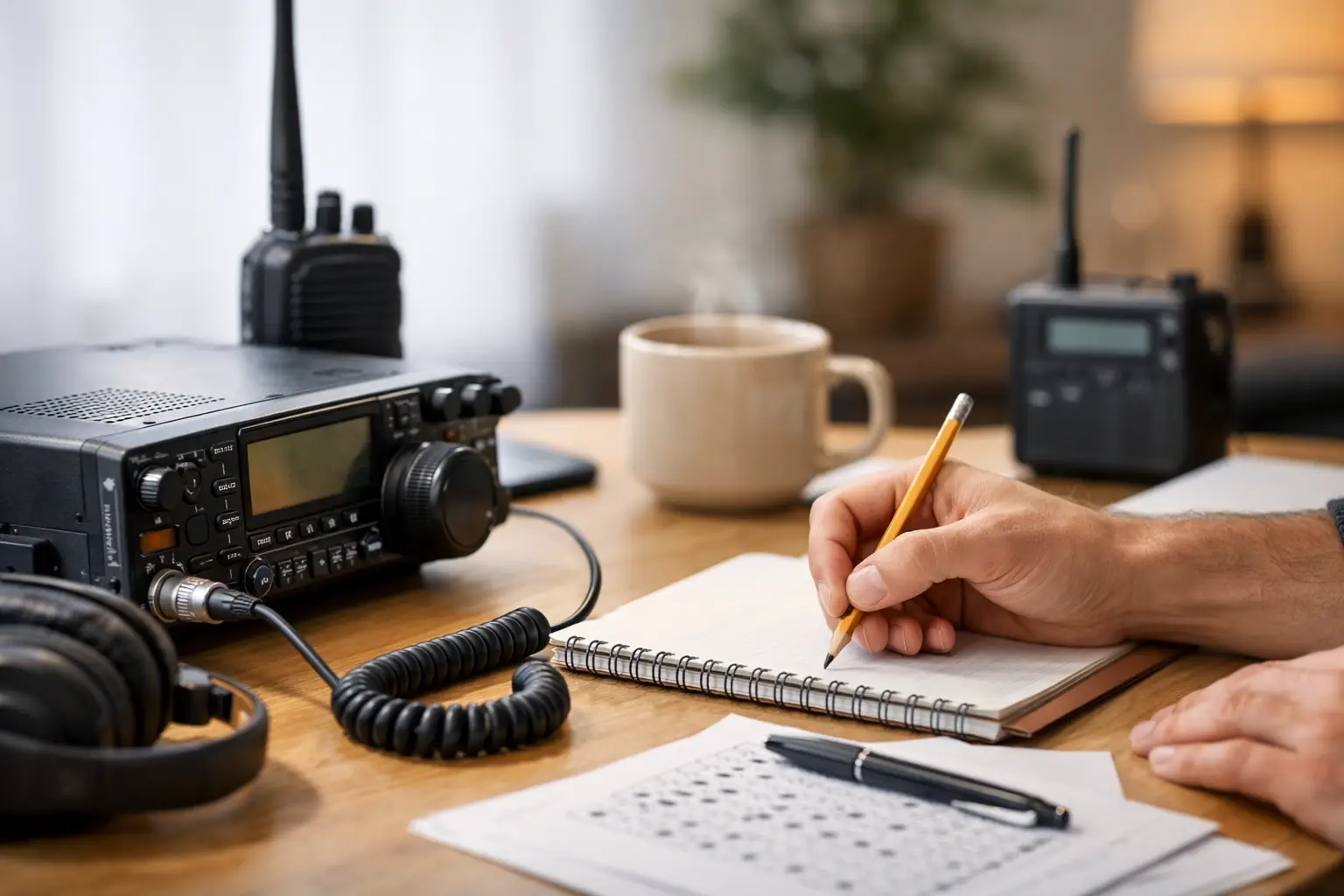
Read all instructions from your exam team carefully before the appointment. Confirm the identification you need, the device and internet connection you will use, and the requirements for your testing space. A quiet room with good lighting, a stable internet connection, and a clear work surface is the right starting point.
Remote proctors may ask you to show your room and desk area using your camera. This is a normal part of confirming that no unapproved materials or devices are available. Clear the area ahead of time so you are not trying to make decisions while the session is underway. Put away notes, books, additional screens, smartwatches, and anything else that is not permitted.
It also helps to test your camera, microphone, Zoom access, and device battery or power connection in advance. If possible, ask other people in your household not to use high-bandwidth internet activities during your exam appointment. These small steps are not about creating a perfect environment. They are about preventing avoidable distractions.
Use a Calm Test-Day Routine
You do not need an elaborate ritual to perform well. You need enough time to arrive prepared and settled. Avoid scheduling your final study session for the few minutes before your exam. Last-minute review can sometimes help, but it can also introduce doubt about material you already know.
Give yourself time to eat, hydrate, and set up your space. Sign in early if your instructions allow it. Keep your government-issued photo ID ready, and make sure your device is positioned so you can follow proctor directions comfortably.
During the exam, read each question fully before looking at the choices. Watch for words such as “best,” “maximum,” “minimum,” and “not,” which can change what the question is asking. If a question feels difficult, do not assume you are failing. Every exam includes questions that feel easier and questions that require more thought.
Use the time available to review marked questions, but be cautious about changing answers simply because you are second-guessing yourself. Change an answer when you identify a specific reason your original choice was incorrect, not because nervousness is asking for certainty that no exam can provide.
Know What to Do If Something Goes Wrong
A low-stress experience does not mean nothing unexpected can happen. An internet interruption, a device issue, or a sudden household distraction may occur. The most helpful response is to remain calm and follow the proctor’s instructions. Do not try to solve a testing problem on your own in a way that could create confusion about exam security.
This is one reason to choose an organized examination team that provides clear communication and human support. MidTENN Nationwide Testing offers ARRL-certified remote exam sessions with structured proctoring and prompt results, helping candidates focus on the exam rather than the logistics around it.
If you do not pass on the first attempt, treat the result as useful feedback, not a verdict on whether you belong in amateur radio. Review the areas that caused trouble, continue practicing, and schedule another attempt when your scores show you are ready. Many capable operators have needed more than one try at a license exam or an upgrade.
Let the Goal Be Bigger Than the Test
The exam is a checkpoint, not the whole hobby. Your license can lead to local nets, public service, emergency communications, technical projects, mentoring relationships, and conversations with people you would otherwise never meet. Keeping that purpose in view makes a few weeks of focused study feel worthwhile.
Prepare steadily, set up your testing space early, and allow yourself to be a learner. When you meet the exam with knowledge and a clear process, test day becomes one more step toward getting on the air.